

The Pop pioneers who saved joik
By Eila Máret Eira (journalist)
Published: 16.05.2026, 08:35am
Updated: 16.05.2026, 10:03am
Translated into English by Diana Oakes
In the early ‘70s, the Sámi people were nearly invisible and joik was about to disappear.
But in Tana, some young people began to mix joik with guitars and pop music.
Without knowing it, they took the Norwegian chart top spot – and so paved the way for a new generation of Sámi artists.
It’s September 1974. Norwegians have turned on the radio in their living rooms. From the studio, the presenter introduces Norsktoppen, (a very popular weekly radio program on NRK, where listeners voted for their favourite Norwegian songs), with the most popular songs of the week.
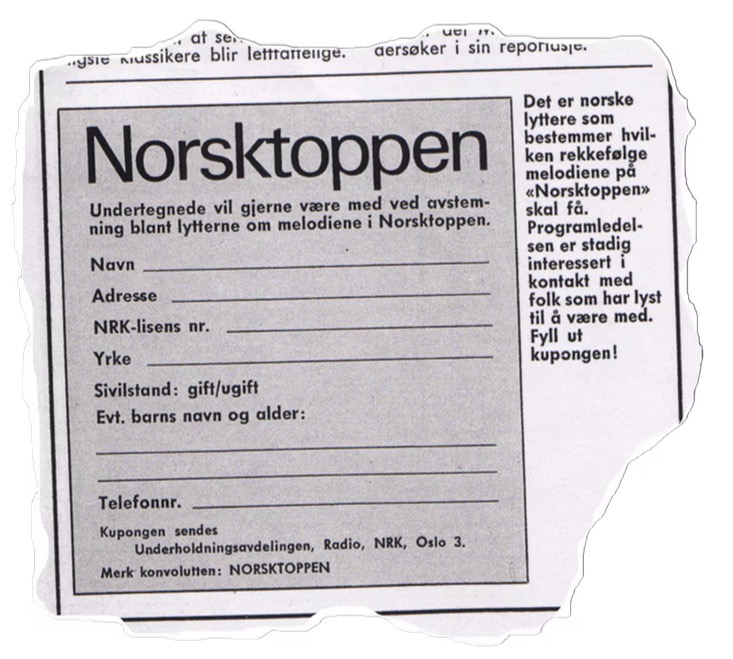
Norsktoppen (1973–2008): Tanabreddens
Ungdom (which translates as “The youth of the
Tana River”) was on Norsktoppen with the songs
“Boares mui’to” and “Deanu Májjá”. Graphics:
NRK
The audience votes, and between Norwegian songs and pop songs, something
unexpected suddenly happens.
A Sámi yoik climbs the national charts
The song is called “Boares mui’to”, (or “Old memory” in Norwegian). The band calls themselves Tanabreddens Ungdom, or “Deatnogátte Nuorat” in Northern Sámi.
The Norwegian people were thrilled by the catchy rhythms, but for the young people this was more than just a hit song.
They themselves may have thought they were just joking about pretty girls, but in reality, this was the start of something much bigger. They were saving an entire musical tradition from dying out.
Tanabreddens Ungdom / Deatnogátte Nuorat
Members: Irene Pettersen, Ingvald Guttorm, Hartvik Hansen, Leif Wigelius and Tore Aslaksen.
The group has also had several different musicians with them over the years.
They have released three records in the 1970s and one CD in 2001:
“Dædnogádde Nuorat” (MAY 1974)
“Dædnogáddis” (Jårgalæddji 1976)
“DædnogáddeNuorat 3” (Jårgalæddji 1979)
“Deatnogátte Nuorat – Buoremusat” (Iđut 2001, CD)
Source: Deatnogátte sámesearvi
The Sami language was disappearing
At this time, the Norwegianisation process, (“dáruiduhttin” in North Sámi), still characterised Sápmi, with full force.
The yoik was seen as something of the past, and was banned in several places, including in schools and churches.

A silhouette of a head with a blue hat with
brown and white details. The silhouette has a
finger in front of its mouth, as if asking for
silence. The image is an illustration with a black
background. (The image description is written
by an AI service)
Graphic: Jonna Dunfjeld-Mølnvik / NRK
For generations, the state had pursued a heavy-handed assimilation against the Sámi people. The Sámi language was still rarely used in schools. The joik, or ‘luohti’, was also labelled in many circles and by the church as ‘pure sin’. Among the young, the Sámi identity was being erased.
“Kofta (the Sámi folk clothing, ‘gákti’ in North Sámi) and duodji (the Sámi traditional handicraft and applied art) were disappearing, it was almost as if the only Sámi thing on display was a Sámi doll or guksi (traditional wooden cup) that hung as a decoration in the car window,” recalls singer Irene Pettersen.

Hit a nerve
But in Tana something started to happen.
The young people Leif Wigelius, Ingvald Guttormsen and Hartvik Hansen got instruments and started experimenting.
They mixed the traditional joik, which was on the verge of disappearing in the area, with modern music.

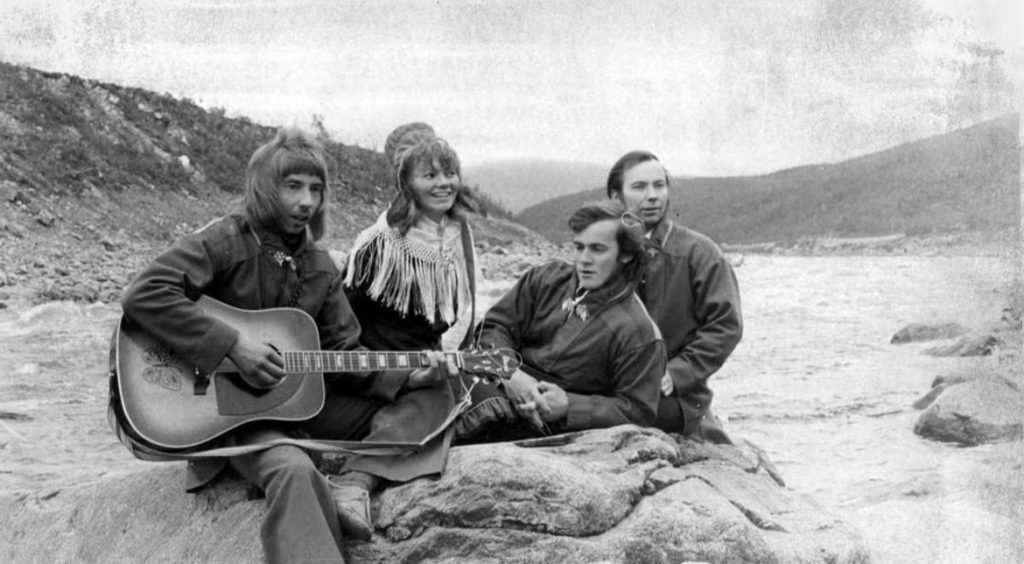
in Jokkmokk, in 1974. PHOTO: Private collectioneenshot
The result struck a nerve with the younger generation, who liked what they heard, but success came at a price.
Touching the joik was taboo. Modernising it was an insult to many, especially the elderly.
“Either we joik traditionally or we make hymns out of joik, some people thought”, says Tore Aslaksen about the reception from parts of the Sámi community.
25,000 records sold
Despite the resistance of the older generation, the music spread like wildfire. When the band, which eventually included Irene Pettersen’s vocals, took the Norsktoppen, something happened to the Sámi self-confidence.
“It was as if the young people suddenly woke up at the time they started listening to us. Any culture that is going to survive must renew itself, and we did that with the joik.” (Irene Pettersen)
Tanabreddens Ungdom sold 25,000 records in a time long before digital streaming services and were awarded a Silver record. The record stores had to be constantly replenished with the popular cassettes and records.

A necessity
That Tanabreddens Ungdom ended up on the charts at this time was not just a coincidence, but a necessity. That’s what associate professor at Sámi University College (Sámi allaskuvla) Katri Sarak Somby believes.

‘A woman smiles at the camera
with her hand under her chin. She
is wearing a blue jacket with a
floral pattern. Behind her is an
indistinct picture on a wall. (The
image description was created by
an AI service). Photo: Svein Harald
Lian
Associate professor and music enthusiast Katri
Sarak Somby has written a doctoral thesis on
the Sámi movement between 1968 and 1990 –
precisely during the period when Tanabreddens
Ungdom broke through.
“They became known at a time when the Sami
community really needed it and managed to mix
popular folk pop with the traditional”, explains
Somby. She emphasises that this was about
more than just melody. It was about survival.
“There is no doubt that Sámi artists after them
stand on their shoulders”, says Somby.

without Ingvald Guttormsen and founder Leif Wigelius, who passed away in 2019. Instead,
namesake Leif Jakobsen stepped in on keyboards. Photo: Eila Maret Eira / NRKt
Tribute by the world star
It’s been over 50 years since the group from Tana made history.
In a back room at the Sámi House in Oslo, the veterans are sitting together after playing a long-awaited memorial concert for a packed hall.
NRK has brought a greeting to the back room. The words come in an e-mail from a woman who knows the legacy of the Tanabreddens Ungdom better than anyone: Mari Boine
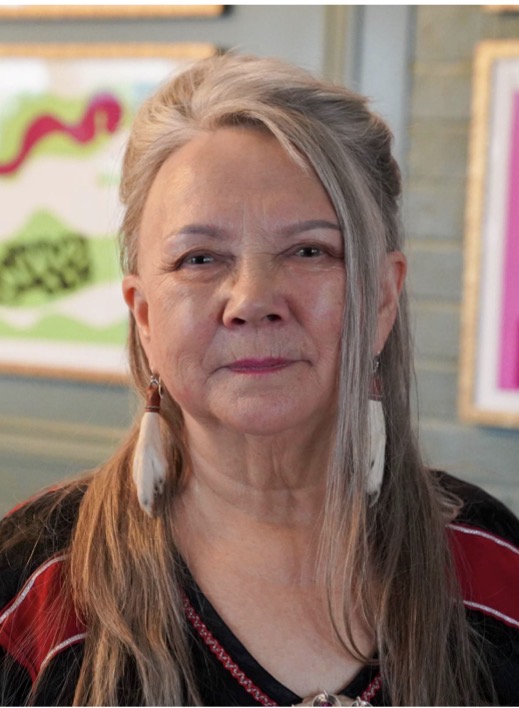
“Of course, I also listened to a lot of
Deatnogátte Nuorat’s music. They were hugely
popular at the time, long before I even
considered starting to sing myself.
Together with Áillohaš, Ammun Johnskareng
and Ann Jorid Henriksen, they helped
strengthen the self-confidence of us Sami youth.
They paved the way for me and other artists of
my age. They were our guides.
Irene’s voice in particular hit me right in the heart, and they had joiks
and lyrics that inspired us to get involved in our own culture.”
Mari Boine (artist)
Mari Boine. Perhaps Norway’s biggest Sámi world star. Photo: Solveig Norberg /
NRK
The room becomes completely silent. You can see a proud smile on Irene’s face. But
the road here has been difficult.
“I have always been afraid to go on stage. I always have been, and I am still today.
Sometimes I almost regret it before I go on stage”, Irene confesses and adds: “It’s a
great honour to hear Mari Boine say those words, she is a world star. The fact that
she says such nice words about us is very nice to hear”, says Pettersen.
The legacy lives on
When today’s Sámi pop stars take to the stage, the fear of singing in their native
language is replaced by the deepest sense of self. Today, Sámi music is streamed
by millions. Today, artists like Ella Marie Hætta Isaksen and KEiiNO fill arenas from
Kautokeino to China.
For Keiino frontman Fred Buljo, it’s essential to express Sámi identity in front of a
worldwide audience. But he knows full well that this freedom did not come by itself.
“They are Sámi legends. The pop pioneers were the first to mix instruments
and joik. They showed that it’s completely okay, and they have inspired the new
generations that make Sámi music today”, Buljo tells NRK, just days after he
returned home from a tour in America.

The proof that the legacy lives on is not only found in the history books. It is also found in Buljo’s pocket. He takes out his mobile phone and smiles slyly.
“I want to make a cover of the song “Eadnái”. I asked for permission, and I got it. It’s the finest joik there is, and I already have a little demo here on my phone”, he reveals.

The song was originally released by the band Idja – a group that consisted of some of the same members from Tanabreddens Ungdom, under a different name. But for Buljo, it’s still the same important musical legacy that he now carries on.
Without knowing it at the time, perhaps the innocent joiks about pretty girls were one of the reasons why stars like Mari Boine and Fred Buljo can fill stages internationally today.
As Irene herself sums up the last 50 years in a down-to-earth way: “Usually things go well, and it’s just really nice when people welcome us so well.”